Credit Utilisation Ratio: Meaning, Formula & Ideal Range
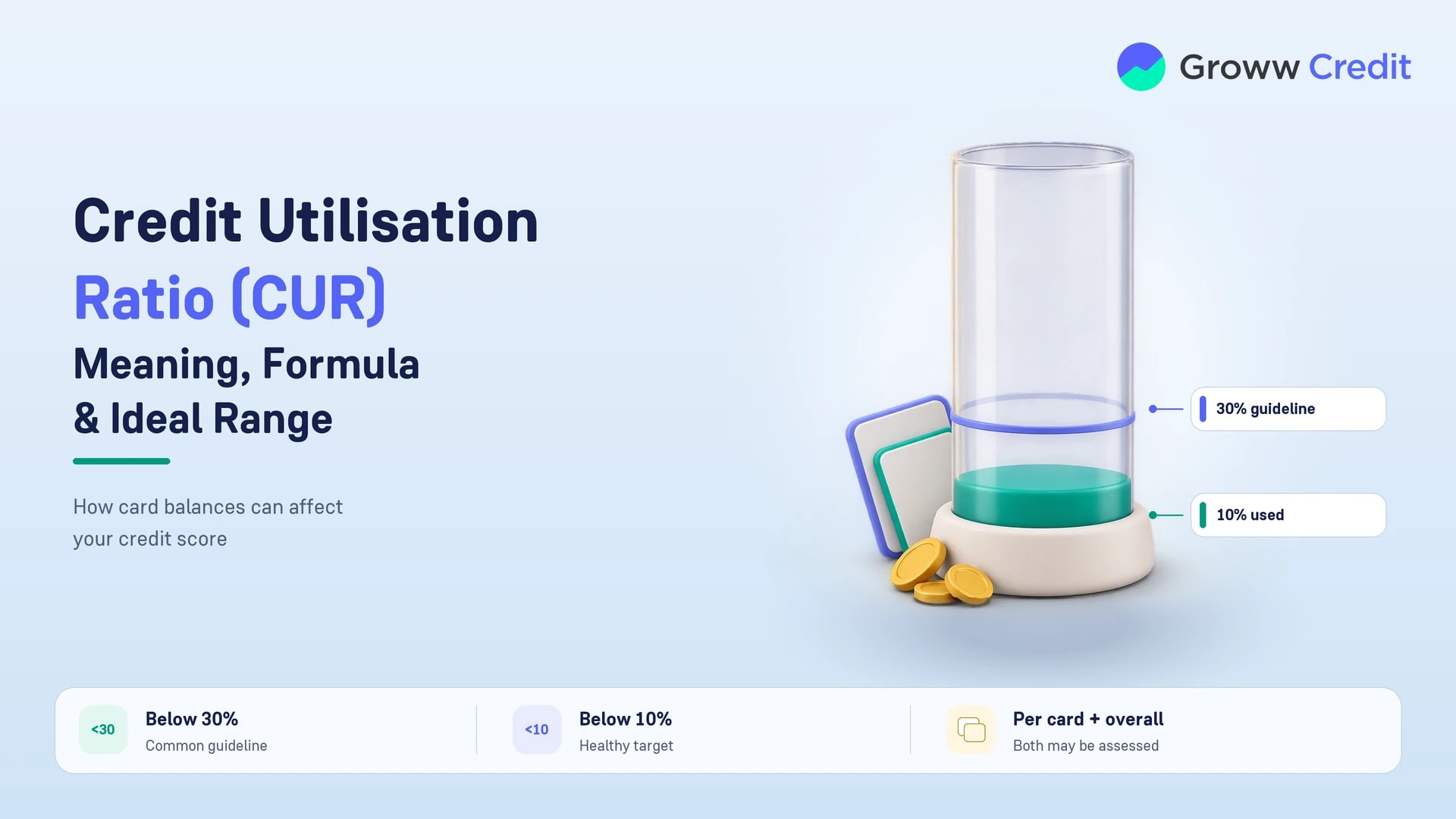


The credit utilisation ratio (CUR) is the percentage of your total available credit you currently use. You calculate it by dividing your total credit card balance by your total credit card limit. Your ideal CUR should be below 30%, but aiming for below 10% is best to maximise your score.
Credit utilisation is a key factor that can affect your credit score. The weight of credit utilisation varies by bureau and scoring model, so it shouldn't be assigned a fixed percentage across all credit scores in India.
A lower credit utilisation ratio generally indicates less reliance on available revolving credit, and a higher ratio may signal greater reliance on borrowed funds and could negatively affect your credit score. Let us learn more about the CUR, its meaning, formula, and ideal range, along with other key factors.
Key Takeaways
- A credit utilisation ratio below 30% is generally considered to be the rule of thumb in India. That's the percentage of your available credit limit that you are currently using.
- The CUR is calculated as: (total outstanding balances / total credit limit) x 100.
- Credit utilisation is a key factor in credit scoring. The 30% rule is a widely cited guideline (i.e., keep your credit utilisation below 30%), although utilisation's effect on your score varies by model.
- Lenders report credit information to bureaus periodically, and the balance shown in the report may not match the balance on the card.
- Some CUR optimisation strategies include clearing dues before the deadline, requesting higher limits (with lower spending), keeping old credit lines open and spreading purchases across multiple cards.
What is Credit Utilisation Ratio?
The credit utilisation ratio (CUR) is the percentage of your total available revolving credit limit that you are currently using. You calculate it by dividing your total outstanding balance by your total credit limit, then multiplying by 100.
Credit utilisation is a key factor in credit scoring. Credit information companies (TransUnion CIBIL, Experian, Equifax) use this information to produce a credit report and score based on their own scoring models.
Credit utilisation is one of the key factors in credit scoring (alongside payment history, credit history and recent credit enquiries). A high CUR will generally have a negative impact on your score as it suggests you're relying heavily on your available credit.
The 30% rule is a widely accepted guideline for utilisation, though the exact figure that is optimal and the effect it will have will vary from one scoring model to another.
Credit utilisation is generally calculated by dividing your outstanding credit card balance by your total available credit. You can look at it card by card or across all your cards.
How to Calculate Credit Utilisation Ratio
To calculate your credit utilisation ratio, divide your total credit balance by your total credit limit. Then, multiply it by 100. So, the formula is the following:
Credit Utilisation Ratio = Total Credit Balances/Total Credit Limits x 100.
Key Steps:
- List Balances: Add up the current outstanding balances on all your revolving credit cards.
- List Limits: Add up the maximum credit limits for each card.
- Division: Divide the total balance by the total credit limit.
- Multiplication: Multiply this final decimal value by 100. This gives you the specific percentage.
Here is an example given below that will help you understand the process better:
Let's say you have two cards with credit limits of ₹1,00,000 and ₹2,00,000, respectively.
|
Credit card |
Credit limit |
Outstanding balance |
Individual CUR |
|
Card 1 |
₹1,00,000 |
₹20,000 |
20% |
|
Card 2 |
₹2,00,000 |
₹10,000 |
5% |
|
Total |
₹3,00,000 |
₹30,000 |
10% |
Overall CUR = (₹30,000 ÷ ₹3,00,000) × 100 = 10%.
So, as the above example goes, you are in a healthy CUR zone, where you are maintaining a credit ratio (overall) of 10% (it is recommended to keep it below 30%). Now, let us take an example where you are not in a healthy zone, i.e. your credit utilisation ratio is high, assuming the same two cards mentioned above.
|
Credit card |
Credit limit |
Outstanding balance |
Individual CUR |
|
Card 1 |
₹1,00,000 |
₹50,000 |
50% |
|
Card 2 |
₹2,00,000 |
₹80,000 |
40% |
|
Total |
₹3,00,000 |
₹1,30,000 |
~43% |
Overall CUR = (₹1,30,000 ÷ ₹3,00,000) × 100 = 43.33%.
Overall CUR is ~43.33% in this instance, well above the 30% benchmark and could negatively impact your score (depending on the model). Lenders will also assess utilisation on an individual-card basis when evaluating your credit.
Credit Utilisation Per Card vs. Overall
Credit scoring bureaus in the country, i.e., CIBIL and others, usually assess not just overall credit utilisation but also per-card utilisation, as stated above. However, overall utilisation usually carries considerable weight. Per-card utilisation is calculated for each credit card by dividing the balance by its limit. Overall utilisation is calculated by combining the limits and balances of all active credit cards in your portfolio.
Let us look at some of the major differences in this case:
|
Key Aspect |
Per-Card Utilisation |
Overall Utilisation |
|
Scope |
Single card balance vs. the single card limit |
Sum of all the credit card balances vs. the sum of all the card limits |
|
Suitable Target |
Keeping utilisation below 30% on each card is commonly recommended |
Keeping combined utilisation below 30% is commonly recommended |
|
Risk Indicator |
High utilisation on an individual card may indicate greater reliance on that particular credit facility |
High overall utilisation may indicate greater dependence on revolving credit |
Avoid maxing out a single card, even if your total utilisation is below 20%. Try to keep your utilisation low on each individual credit card even if your overall utilisation is relatively low.
High utilisation on one single card can negatively impact your credit profile, even if your overall utilisation across multiple cards is relatively low.
You can spread your spending across cards to keep individual utilisation down, provided of course you can pay the full balance off each month and on time.
What is a Good Credit Utilisation Ratio?
A credit utilisation ratio under 30% is generally regarded as a good benchmark. Some people will aim for a utilisation ratio of well below 10%, but there is no magic number that will necessarily result in a higher credit score.
Credit utilisation is one of the factors that goes into the calculation of your credit score, though the weighting of that factor will vary from one credit reporting body to another and from one of their scoring models to another.
Let us look at the utilisation tiers and the impact on the score:
|
Credit utilisation |
General interpretation |
|
Below 10% |
Low utilisation; generally a healthy target |
|
10% to below 30% |
Generally within the commonly recommended range |
|
30% to below 50% |
Higher utilisation; may affect your credit score |
|
50% and above |
High utilisation; may indicate greater reliance on revolving credit |
These are general guidelines, not official CIBIL score bands. The actual impact on a credit score depends on the scoring model and the rest of the borrower's credit profile.
Utilisation Percentages: Quick Verdicts
Your credit utilisation ratio is the percentage of your total available credit limit that you're using. Credit utilisation is a key factor in your credit score and measures how much of your available revolving credit you're using. The impact on your score varies by model.
Let us look at some major utilisation percentages and quick verdicts.
|
Utilisation |
General interpretation |
What to know |
|
0% |
No reported revolving balance |
A zero balance is not inherently harmful. Credit history and repayment behaviour remain important. |
|
Above 0% to below 10% |
Low utilisation |
Generally a healthy level, although it does not guarantee a score increase. |
|
10% to below 30% |
Moderate utilisation |
Usually within the commonly recommended range. |
|
30% to below 50% |
Higher utilisation |
May negatively affect your credit score. |
|
50% to below 100% |
High utilisation |
May signal greater reliance on available credit and affect creditworthiness. |
|
100% or more |
At or above the credit limit |
Indicates that the reported outstanding balance equals or exceeds the reported credit limit. |
These ranges are illustrative guidelines, not official CIBIL rating categories. Credit utilisation alone does not determine whether a loan or credit card application will be approved.
How Credit Utilisation Affects Your Credit Score
Credit utilisation is a key factor that can affect your CIBIL score. It's the percentage of your available credit limit that you're currently using. A high level of utilisation is likely to be detrimental to your score, whereas a relatively low level of utilisation is generally preferred.
The actual effect will of course vary depending on the credit scoring model and your individual credit profile.
- Importance: Credit utilisation is one of the factors which can affect your CIBIL score.
- High utilisation: Consistently high credit card balances relative to your available credit limit can negatively impact your score.
- Low utilisation: Keeping your balances low relative to your available limits is generally advised but won't necessarily increase your score.
- Individual and overall utilisation: Both individual card utilisation and overall utilisation may be relevant to credit assessment.
Common Mistakes That Push Your Ratio Up
Several common errors can drive your ratio (CUR) up. This can be a big deterrent to keeping your CUR below 30%. Here's what you should avoid in this scenario:
Mistake 1: Closing Your Old Cards
- Closing a credit card will reduce your total available credit. If your balance stays the same, this will increase your overall credit utilisation and could affect your score.
- You should also consider any associated fees, how you use it, and whether it's the right card for your circumstances.
Mistake 2: Paying Just the Minimum Due Amount
- Paying only the minimum will result in interest charges on the remaining outstanding balance.
- It may also keep your credit utilisation ratio quite high if the balance continues to grow.
Mistake 3: Ignoring the Statement Generation Dates
- Lenders report their credit information to the credit bureaus on a periodic basis, so the balance shown on your credit report may not be the same as your current balance.
- If you pay off your account before the lender reports the information, you may see a reduction in your reported utilisation, although the timing depends on the lender's reporting cycle and the bureau's processing time.
- Since lenders report credit information periodically, the balance reflected in your credit report may not immediately reflect payments or transactions made after the reporting date.
Mistake 4: Maxing Out Just One Card
- High utilisation on a single card can affect your credit profile, even when the overall utilisation is low.
Mistake 5: Applying for Sudden Credit Increases
- Multiple hard inquiries can signal higher financial stress.
- Maxed-out new credit limits can increase the risk of instant dependency.
- Applying for multiple credit cards/loans within a short period can lead to multiple hard enquiries on your credit report. These frequent credit applications may affect your credit score and could signal increased reliance on borrowing from lenders.
How to Reduce Your Credit Utilisation Ratio
Now comes the most important part- how do you reduce your credit utilisation ratio? Here are some strategies that will help you fix and reduce it efficiently.
- Pay prior to the reporting date if you want to reduce the balance that appears on your credit report. Your lender may report the account on a date which is different to the statement date.
- A credit limit increase can actually reduce your credit utilisation ratio if your balance doesn’t change. The lender must report the new limit, and it must appear on your credit report, before it will affect your reported ratio. Continue spending within your repayment capacity.
- Keep suitable credit accounts open, as an unused card counts toward your available credit limit. Just be mindful of the annual fee, the terms, and the card’s security before you decide to keep it.
- Manage your spending across the cards. Keeping your utilisation low on each card may help, but don't go to the lengths of spending or borrowing just to spread the balances.
- Make the payments regularly. Paying down outstanding balances during the billing cycle will help to reduce your credit utilisation, especially if the lower balance is then reflected in the lender's next credit bureau submission.
- Pay the full amount due: paying the full statement balance by the due date helps you avoid interest on ordinary purchases (subject to the applicable card terms) and prevents balances from accruing.
Conclusion
The credit utilisation ratio is a key metric for managing your credit card balance and maintaining a good credit profile. The key is to keep your outstanding balance low relative to your credit limit, make payments on time, and avoid overborrowing.
A credit utilisation ratio below 30% is commonly recommended as a general guideline. However, its actual impact on your credit score depends on the scoring model and your overall credit history.
FAQ's
What is a good credit utilisation ratio in India?
A credit utilisation ratio of below 30% is generally considered a good guideline in India. That's the ratio of your available credit that you're using. Keeping your utilisation relatively low is generally a good thing, though the impact on your score will vary depending on the scoring model and your individual credit file.
Is 30% credit utilisation high?
A credit utilisation ratio of 30% is often seen as the upper threshold you should aim for, rather than a strict dividing line between good and bad credit habits. It is usually best to keep your utilisation below 30%, but no single percentage guarantees a specific credit score.
What happens if I use 90% of my credit limit?
Using 90% of your available credit limit is extremely high credit utilisation and could negatively affect your credit score. It may also affect how a lender views your credit. The actual effect varies by scoring model and your overall credit profile, and high utilisation doesn't necessarily mean a loan or credit card application will be turned down.
Is credit utilisation calculated per card or across all cards?
Credit utilisation can be viewed both on an individual card basis and as a total across all your cards. High utilisation on one card can adversely affect your credit profile even if your total utilisation is quite low. The degree to which individual and total utilisation will impact your score will vary depending on the scoring model.
Does increasing my credit limit automatically lower my utilisation?
Increasing your approved credit limit will reduce your credit utilisation ratio (assuming your balance stays the same). The new limit will only affect your utilisation ratio once it's reflected in the credit information your lender reports. If you keep your spending the same or reduce it then you'll benefit from the higher limit.
Is 0% credit utilisation good for my score?
A 0% credit utilisation ratio does not negatively affect your credit score. At the same time, keeping your credit card balance at zero will not automatically improve your score. Your credit score is also shaped by other factors such as your payment history and the length of your credit history. It is not necessary to carry a balance or pay interest to show that you are managing your credit responsibly.
Does credit utilisation apply to personal loans and EMIs?
The credit utilisation ratio usually applies to revolving credit like credit cards. In contrast, personal loans with a fixed tenure and regular EMIs are not included in this calculation. Even so, details such as your loan balances, how you repay your loans, and other related information still play a role in determining your overall credit score.
How quickly does paying down a balance lower my utilisation?
Under the updated credit information reporting framework from the RBI (which came into effect on 1st July 2026), credit institutions are required to report their credit information on the 9th, 16th, 23rd and the final day of each month, with the reports generally due within four calendar days of the reference date. The credit information companies also have their own processing timelines. So the balance could appear sooner than the previous 30-45 day estimate, though timing will vary.