CIBIL Score Range Explained: Meaning, Bands, and What Makes a Good Score


The CIBIL score is a three-digit numerical summary of your credit history that ranges from 300 to 900. A CIBIL score is generally considered good if it is above 700, which can help you get faster financial support and competitive loan terms and conditions when you need them most.
TransUnion CIBIL issues this score, which reflects your creditworthiness based on the types of credit/loans you have, your earlier repayment behaviour, and your credit utilisation. Lenders use it to benchmark lending risk when you apply for new credit. Learn more about the CIBIL score range, what it means, the bands, and other important aspects below.
Key Takeaways
- TransUnion CIBIL issues the CIBIL score as a three-digit figure from 300 to 900. This score reflects your overall creditworthiness and repayment history over time.
- A CIBIL score of 300-549 is generally considered poor, while 550-699 is considered fair/average.
- CIBIL score of 700 and above is generally considered good.
- Lenders view a score of 750 or higher favourably, as it indicates responsible credit management and lower default risk.
What is a CIBIL Score?
The CIBIL score is a three-digit figure from 300 to 900 that shows your credit health and the likelihood of repaying a loan. You can easily check your score details on the official CIBIL site.
CIBIL stands for Credit Information Bureau (India) Limited, India's first credit information company (credit bureau), authorised by the Reserve Bank of India (RBI). It now operates as TransUnion CIBIL after TransUnion, a global credit agency, acquired it.
CIBIL gathers financial records and loan repayment histories from various lenders and banks, creating this three-digit figure between 300 and 900. Lenders use the score to assess whether an individual or business is safe enough to receive a loan or credit card.
A score that is closer to 900 indicates a strong credit profile and is associated with higher chances of loan approval. 750-900 is generally considered by lenders as a range where you are viewed as a safe borrower. However, 300 to 649 is a non-favourable score, and lenders may reject your loan or credit applications.
Factors Influencing CIBIL Score
- Repayment history (whether you have paid your EMIs and other bills on time).
- Credit utilisation (using only a small part of your overall credit limit).
- Credit mix (a healthy mix of secured loans like home/auto loans and unsecured loans like credit cards can positively influence your credit profile).
- Credit inquiries (whether you have applied for too many credit cards or loans in a short duration).
How is CIBIL Score Calculated
The CIBIL score is derived from the Accounts and Enquiries sections of your CIBIL Report. This uses five core weight factors based on the calculation parameters.
- Payment History:
-
- Monitors timely payments on credit cards and past loans.
- Defaults on credit or delayed EMIs reduce this score considerably.
- Credit Utilisation:
-
- Measures the percentage of your available credit limit that you use.
- Keeping utilisation below 30% will help you maintain a high CIBIL score.
- Age of Credit History:
-
- This assesses how long your oldest credit accounts have remained more active.
- Older accounts may indicate long-term stability.
- Credit Mix:
-
- This analyses the balance of secured (car or home loans) and unsecured (credit card or personal loans) credit.
- Most lenders and banking institutions view a more balanced mix more favourably.
- Credit Enquiries/New Credit:
- Hard inquiries from new credit applications are counted.
- Lenders may view you as credit-hungry if you make frequent credit applications in a short period.
How to Check Your CIBIL Score
Here are the steps to check your CIBIL score:
- Go to the official CIBIL platform or any other authorised credit marketplace.
- Enter the personal information the CIBIL platform requests to verify your identity, such as your name, date of birth, and identification details.
- Enter the OTP (one-time password) sent to your registered mobile number to verify your identity.
- You can now access your dashboard to view your 3-digit CIBIL score (between 300 and 900), along with a detailed credit report.
CIBIL Score Range: Minimum and Maximum Explained
As mentioned earlier, the CIBIL score in India ranges from 300 to 900. Here’s a look at these two figures in more detail:
- Minimum Score (300) and What It Means:
-
- It is the lowest possible credit score that you can get in the Indian system.
- A score at the lower end of the CIBIL range indicates a weaker credit profile and may make it harder to get credit.
- Lenders may view applicants with a very low score as higher credit risk, which can reduce approval odds.
- Maximum Score (900) and What It Means:
-
- This is the highest possible credit rating that you can achieve in the Indian financial system.
- This score reflects an excellent credit profile and discipline, including timely repayments and optimal credit management.
- This score will automatically strengthen your credit application, speed up loan approvals, and sometimes give you access to higher credit limits and attractive interest rates.
CIBIL Score Ranges and Their Meaning
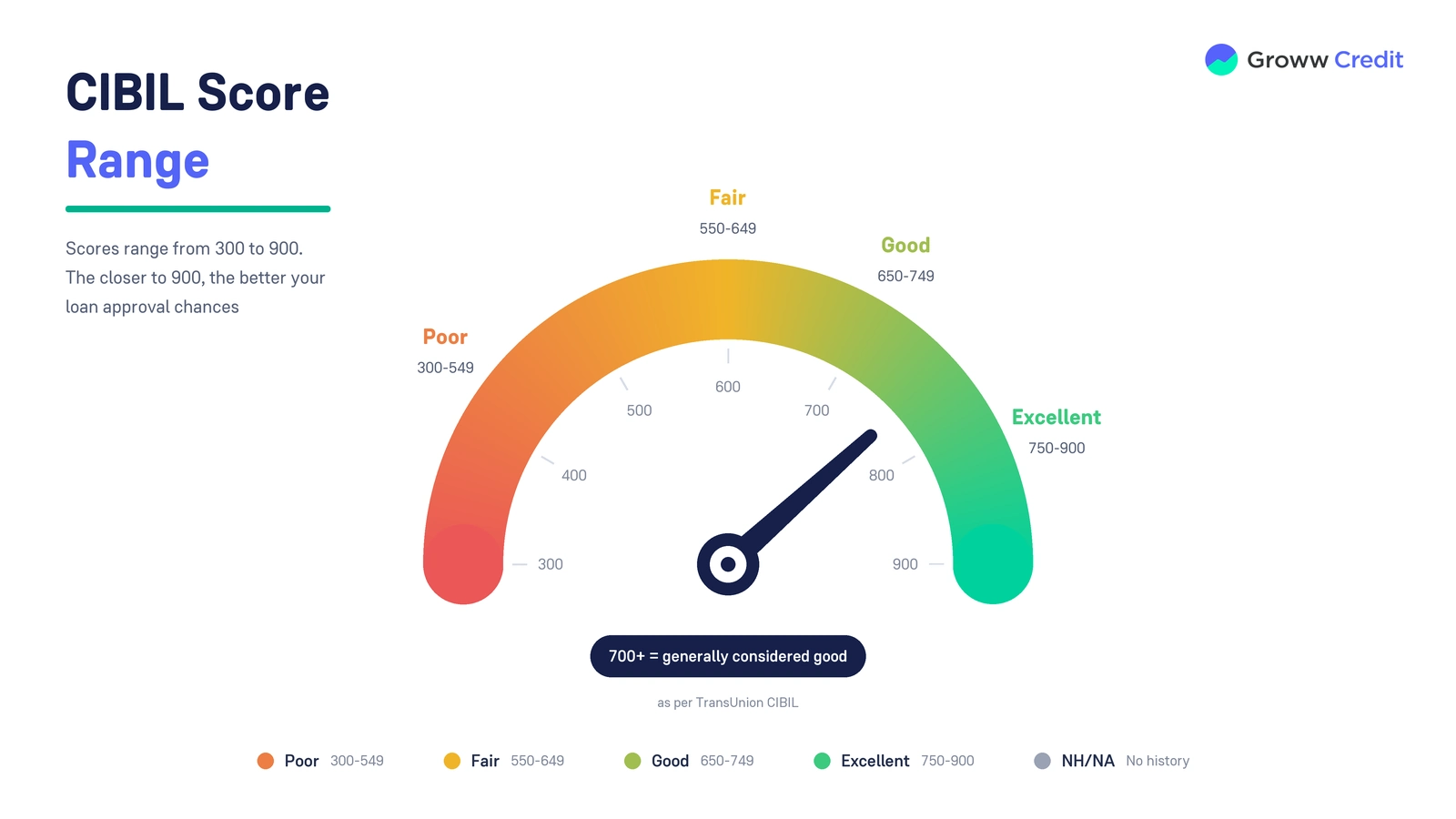
Understanding the different CIBIL score ranges and what they mean is essential. Here is a closer look.
|
Score band |
What it signals |
Typical lender treatment |
|
750-900 |
This range indicates an excellent credit history and timely repayments on loans and credit cards over the years. |
You may get loan or credit card approvals instantly, along with considerably lower interest rates than your peers. Lenders usually view these applicants as favourable. |
|
650-749 |
This indicates good, dependable credit behaviour. |
In most cases, you have a higher chance of loan or credit card approval. The rates will also be fair and sometimes lower than those with CIBIL scores below this range. |
|
550-649 |
This indicates average or fair credit risk. It indicates higher credit risk than the upper tiers, but not as risky. |
With this score range, the lenders start getting a little more hesitant. They may charge you higher interest to offset the higher risk, or even ask for a co-applicant to approve the loan. |
|
300-549 |
It directly indicates a poor history of unpaid debts, dues or even loan defaults. This is the highest-risk tier in the CIBIL system. |
Lenders will view you as a high-risk borrower. Your loan application may be rejected in most cases. Alternatively, even if a loan is approved, it may come with extremely stringent and harsh loan terms. |
|
NH/NA |
This rating means you have no prior credit history. It reflects a lack of previous credit history, not a poor score. |
Lenders will have insufficient credit information to assess the risks. As a result, you will receive starter credit with terms and conditions based on your income and other criteria. |
300-549:
- Meaning: High default risks and multiple missed payments. It may also indicate past loan or credit defaults.
- Lender Perspective: The lender will always view you as a high-risk applicant. In most cases, lenders will reject your credit card and loan applications.
- What You Should Do: Immediately clear your overdue bills and wait for them to reflect in your credit score. Also avoid new credit inquiries for a certain period.
550-649:
- Meaning: This indicates below-average or fair credit behaviour, with occasional payment delays.
- Lender Perspective: Lenders will be hesitant to offer you credit. In this case, you may only get a loan or credit card with higher interest rates and very strict terms.
- What You Should Do: Pay all your current EMIs and other credit card bills on time instead of waiting for your score to improve slightly.
650-749:
- Meaning: This means you have positive, stable credit habits. This score suggests you mostly repay your loans and credit card bills on time.
- Lender Perspective: Most NBFCs (non-banking finance companies) and banks approve credit cards and loans in this score range. However, you may not get the lowest interest rate and the most favourable loan terms and conditions.
- What You Should Do: Try to keep your credit utilisation below 30%. This will help you push your credit score into the highest tier.
750-900:
- Meaning: This reflects excellent credit behaviour and financial discipline. You also have a history of consistent, timely payments without ever defaulting or delaying.
- Lender Perspective: You will get immediate approvals from most lenders in this case, along with obtaining the highest possible credit limits. At this score range, you'll get the lowest interest rates and the most favourable loan terms and conditions.
- What You Should Do: Keep maintaining your healthy credit management practices and habits. However, keep tracking your credit report regularly to spot errors and get them corrected (this may improve your score even further).
Specific CIBIL Scores: Quick Verdicts
What happens when you have a specific CIBIL score and don't know what to expect? Here is a guide to help you understand key aspects of several common CIBIL scores.
|
Score |
What to Expect |
|
600 |
Extremely high risk of your loan getting rejected. If you get approved, you will have to pay really high rates of interest, while needing huge collateral or a co-signer |
|
645 |
This means below-average chances in most cases. Some NBFCs or private lenders may consider your application. However, you should anticipate more stringent scrutiny of your loan application, along with lower credit limits and higher rates of interest |
|
700 |
You are in the safe zone. Most lenders and banks will favourably consider your loan or credit card application. However, you will not get the lowest interest rates in many cases. |
|
750 |
This is a premium score tier and the ideal benchmark score. You can expect quicker loan/credit card approvals, pre-approved credit offers and even very attractive/competitive rates of interest |
|
800+ |
You are a top-tier borrower for the lender. You will have more negotiating power when applying for a loan or credit card. You will also get the lowest possible interest rates, waived processing fees and higher credit limits |
|
900 |
It is theoretically the perfect, or highest possible, score, although it is rare to achieve. If you have it, you get the same premium advantages as an 800+ CIBIL score. Lenders generally consider anything higher than 800 as the gold standard |
What is a Good CIBIL Score Range?
So, after analysing the earlier factors, what is a good CIBIL score range? You should aim for 700 to 749, while 750 or higher is considered excellent (the 750-900 tier). So, 700-749 has higher approval odds with competitive rates, while 750-900 has top approval odds with the lowest rates.
Minimum CIBIL Score for Loans and Credit Cards
Here is a closer look at the minimum CIBIL score for credit cards and loans.
Credit Cards:
- Premium/Travel Cards: 750+ (high credit limits and the best rewards).
- Standard Unsecured Cards: 700-749 (easy approval from top private and public banks).
- Entry-Level/Secured Cards: 650-699 or supported by a fixed deposit.
Loans:
- Home Loans: Usually 700-750; many public sector banks may take 700-720.
- Car Loans: Mostly 700+ for better interest rates.
- Personal Loans: Lenders prefer 750+, although some digital platforms and NBFCs may take 650-700 with higher interest rates.
How to Improve Your Score Before Applying
- Pay your bills on time: Set auto-debits or reminders, and avoid missing any payment. Pay everything before/by the due date.
- Keep your usage lower: Use less than 30% of your overall credit limit, and ask for a higher limit on loans/credit cards. Do not max out your credit cards.
- Check your credit report: Review your CIBIL report regularly, and correct any incorrect information that may have lowered your score (raise online disputes for any errors).
- Restrict new credit: Don't apply for too many loans at once; avoid multiple hard inquiries, and space out requests for new credit cards.
- Maintain accounts: Keep your older credit cards active, and don't close good accounts. Keep a mix of secured and unsecured credit for a better score.
Conclusion
The CIBIL score is an important benchmark of your creditworthiness. Aim for 700-749, while 750-900 guarantees the best credit terms and interest rates. Regularly check your credit report to track your score and fix errors or improve it before applying.
Disclaimer: This article is for informational purposes only and does not constitute financial advice; final loan and card decisions rest with individual lenders, and readers should consult a qualified financial advisor before making credit decisions
FAQ's
Is 750 a good CIBIL score?
Yes, a CIBIL score of 750 is considered very good. Most lenders will view it favourably, indicating a strong credit history and responsible repayment habits. You are likely to get quicker loan/credit card approvals at better interest rates.
Is a 900 CIBIL score possible?
Yes, a perfect CIBIL score of 900 is possible in theory, but very rare in reality. To achieve a perfect credit history, you need the lowest credit utilisation ratio, an excellent repayment history, and the best mix of unsecured and secured loans.
Is the CIBIL score range 200 to 800 or 300 to 900?
The official CIBIL score range is between 300 and 900. A score near 300 reflects a poor credit profile and higher default risks, while a score closer to 900 indicates an excellent credit history and lower default risks.
Is a 645 CIBIL score good?
No, a CIBIL score of 645 is not good. It is only average or fair. Lenders mostly prefer scores of 750 or higher. You may still be eligible for credit with this score at some institutions, but you'll likely face higher interest rates, lower credit limits, and stricter eligibility verification.
Can I get a loan with a 600 CIBIL score?
Yes, you can get a loan with a CIBIL score of 600, although it is quite difficult. Regular banks and other lenders may reject the application because of the higher risk of default. Yet, some NBFCs and digital platforms may accept this score. You may also obtain a loan with this score from regular lenders if you have a co-applicant or collateral (gold loans or loans against property).
Can I have a CIBIL score below 300?
No, the active CIBIL score cannot fall below 300. The scoring range runs from 300 to 900. If the credit report shows 0 or -1, it does not mean a score below 300. It indicates a lack of proper credit history.
What does a -1 or NH CIBIL score mean?
A -1 or NH CIBIL score indicates no history. This status indicates that you are new to obtaining credit or have not used any loans or credit cards so far. So, the credit bureau will not have enough data to generate the numerical credit score.
What is the minimum CIBIL score required for a loan?
The minimum CIBIL score that is preferred for an unsecured loan is usually 750. So, while there is no legal minimum threshold, a 750 score can help you get competitive rates of interest and faster credit approvals. Some lenders or NBFCs may approve loans with scores between 600 and 700, but the terms are stricter and interest rates are higher.